GPR Applications
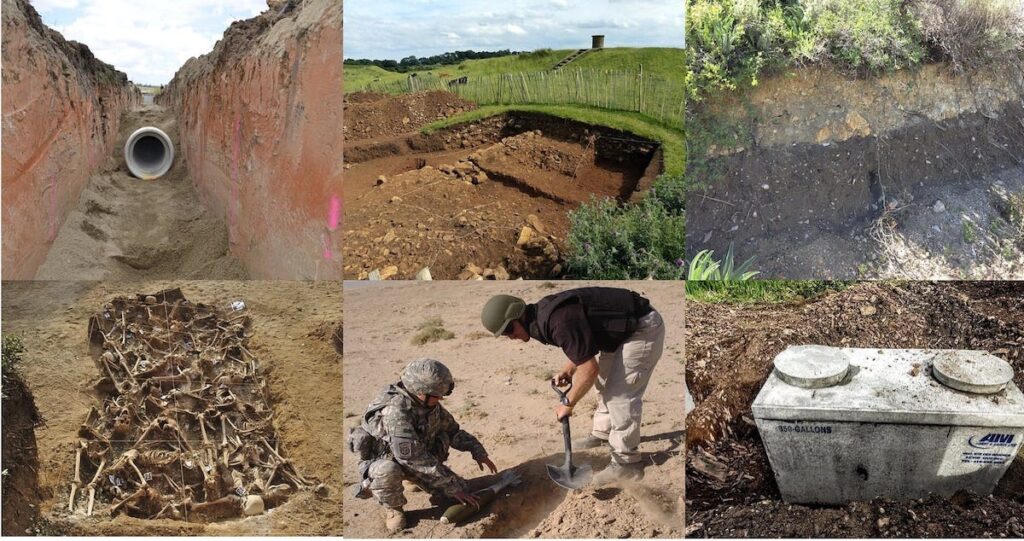
Using a combination of Surface Penetrating Radar (SPR) and Ground Penetrating Radar (GPR), Worksmart has successfully plotted the location of post-tension tendons, reinforcing, and underground utilities contained in concrete slabs via concrete imaging. Our Remote Operated Vehicle (ROV) extends these capabilities into areas not accessible by humans.
Post-Tension Tendons & Concrete
Precise location of post-tension tendons, rebar, and embedded utilities before concrete cutting, coring, or demolition.
Underground Storage Tanks
Detection and location of USTs and related anomalies for environmental assessments and construction planning.
Bore Hole Safety Checks
Pre-drill surveys to identify utilities and obstacles before borehole installation.
Concrete Cutting Safety
Safety scans prior to saw-cutting or coring to avoid striking hidden utilities or structural elements.
Thickness of Cover
Measurement of concrete or soil cover over utilities and structures.
Cemetery Plot Location
Non-invasive location of unmarked graves and cemetery plots.
Under Slab On Grade
Investigation of conditions and utilities beneath slab-on-grade construction.
Water Leaks & Saturated Soils
Detection of water leaks and areas of saturated soil.
Utility Locating
Metallic and non-metallic utility location using GPR and specialized locators.
Post-Tension Tendons
Post Tension tendons are best explained by the experts. Here is a reprint of an article downloaded from the Post-Tensioning Institute: www.post-tensioning.org.
1717 W. Northern Ave., Ste. 114
Phoenix, AZ 85021
Tel: 602-870-7540
FAX: 602-870-7541
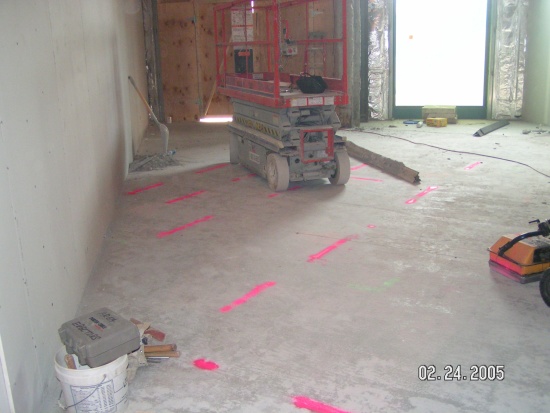
As you can tell it is vital that no damage occur to these post tension tendons or the structural integrity of the building will occur. Post tension tendons and conduits were contained in this scanned concrete floor. The pink paint marks allow the contractor to avoid potential hazards.
Underground Storage Tanks
Locating clandestine under ground storage tanks is a very typical application for G.P.R. Being able to mark out the precise location of a deteriorating tank is very important prior to drilling or excavating operations.
The top measurements were observed when passing over a cross section of the U.S.T., and the lower ones were produced during a longitudinal scan.
The precise location is marked on the surface normally with pink marking paint. Leaving little doubt as to the identity or position of the target.


Bore Hole Safety Check
Whether you are drilling for soil samples or core drilling in concrete slabs, we can scan an area around the bore location and quickly determine the presence of utilities, reinforcing or other structures.


Concrete Cutting Safety Check
Cutting floors in factories, schools, strip malls or any regularly remodeled facility without scanning first can be a dangerous and potentially expensive proposition for any contractor. The facility owner as well may be exposed to down time and severe disruptions should a forgotten utility be destroyed. Below the intricate cutting pattern was laid out in orange paint in advance of the concrete cutting. The pink paint marks show the location of two misplaced utilities contained in the concrete. Knowing the location will allow the cutting contractor to lift the blade and avoid disruption of these utilities.
Thickness of Cover
Determining the thickness of over burden can be a significant benefit in many applications. One example would be determining the volume needed to be excavated of an undesirable material. Also you could determine the volume of bed rock or material needed to be removed before coming to bed rock. A significant clay layer might be of interest and in the area. All of these and more can be determined using our GPR equipment. There is a significant benefit using GPR rather than bore data since GPR data is collected either in 3-D or continuous cross sections rather than just one point.
The thickness of over burden covering this area of buried debris can be quickly determined as approximately 0.9 meters. This could be a desired material layer, water table, bedrock or almost anything.

Cemetery Plots
A real issue in today's crowded and aging cemeteries is whether or not there are plots that could be sold. Documentation in many older cemeteries is limited at best and may not be very reliable. GPR scanning has determined the existence of unoccupied plots, freeing these areas to be sold.


Under Slab On Grade
One of the questions we are asked regularly is whether or not our equipment will find subsurface targets under building slabs with reinforcing. The answer is yes most of the time. As long as the reinforcing is normally spaced, we can "see" under it. Here are a few photographs of areas anomalies were identified under building slabs.


Water Leaks & Saturated Soils
This radar scan depicts an anomaly consistent with saturated soils. Leak detection is relatively easy using a 500 MHz antenna.
Saturated soils can easily be determined using our G.P.R. equipment. Shown is a sketch of a building slab under which a water main had broken. The path the water took resulting in saturated soils under the slab were determined and marked on site.


Utility Locating
In addition to using state of the art GPR equipment to locate metallic and non metallic targets under ground, we also use two types of utility locators. A Metrotech brand locator as well as a Radio Detection unit. These different technologies help to confirm all potential targets are identified.


Worksmart also maintains information on insurance, ISO compliance, sample reports, legal requirements, and references for clients who need supporting documentation.
Discuss Your Project